


Only 5% of crude oil exports from the countries around the Persian Gulf go to Europe. This means that Europe is not directly affected by the blockade of the Strait of Hormuz, and there is no threat of an oil supply shortage. Federal Minister of Economics Katherina Reiche had already called for calm about the issue on Sunday. Even the United States, which is now the world's largest producer of oil and natural gas, imports less than 0.9 million bbl/d from the region. This is according to an analysis by Reuters news agency. The situation in Asia, on the other hand, is quite different: China is currently experiencing oil supply shortages. As the world’s largest importer of crude oil, the country sources around half of its oil from the Middle East and is Iran’s largest customer. Japan also sources 95% of its crude oil from the Middle East, and South Korea, 75%.
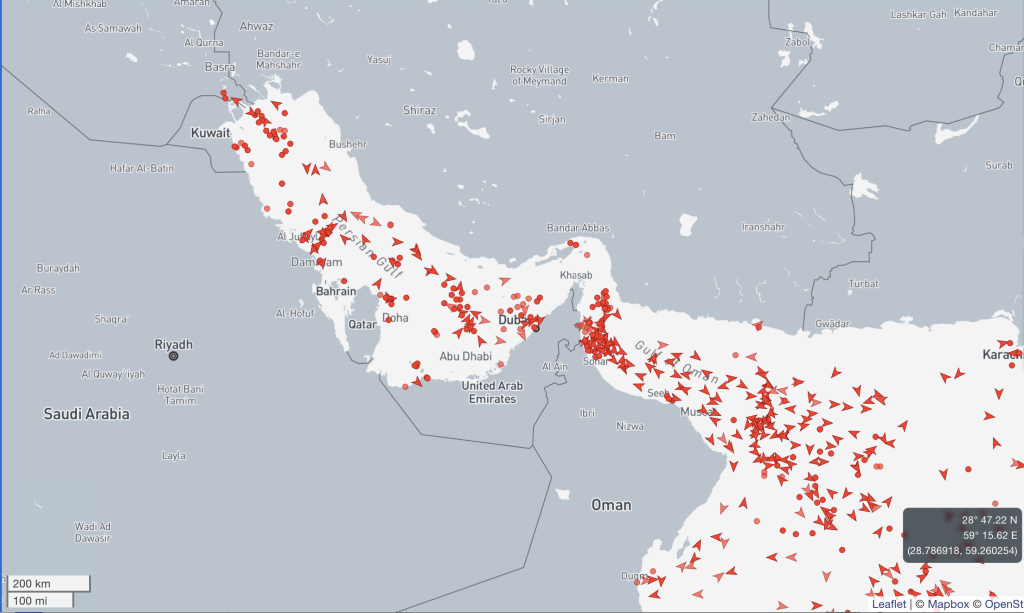
Between 180 and 200 tankers are at a standstill: Data from the MarineTraffic platform shows tankers are backed up on both sides of the strait between Oman and Iran, for example off the port of Fujairah in the United Arab Emirates. Iran has declared the Strait of Hormuz closed. On Monday evening, the commander of the Revolutionary Guards threatened to fire on any ship passing through. International shipping companies, trading houses, and oil companies had already largely suspended their voyages. German ships are now also at anchor.
The Strait of Hormuz is a bottleneck. It is 167 km long and only 33 km wide at its narrowest point, and the shipping lane for large cargo ships is even narrower – only three km wide in places. At the same time, the sea route is the only connection between the Persian Gulf and the open sea (Gulf of Oman, Arabian Sea, Indian Ocean). This means that the oil ports, and thus the oil exports of Kuwait, Iraq, Qatar, Bahrain, Oman, and the United Arab Emirates, are blocked. Only Saudi Arabia and the UAE have an alternative to tanker shipping: pipelines. However, the pipelines can transport significantly less volume: five (SA) and 1.5 (UAE) barrels per day, according to a report by the UAE Ministry of Energy.
One-fifth of global oil production is stuck. The ships that pass through the strait every day primarily transport crude oil, fuel, and liquefied natural gas (LNG). Fertilizers and foodstuffs are also transported through the Strait of Hormuz, but to a much lesser extent. However, the segment most affected is oil trading: According to GTAI, the German Foreign Trade and Investment Agency, 20 million bbl of crude oil passed through the strait every day in 2024. That corresponds to one-fifth of global oil supply. Added to that is around 80 million tonnes of liquefied gas per year, primarily from Qatar – also roughly one-fifth of the global LNG trade.
In the immediate aftermath of the halt to oil shipments, prices for crude oil from other parts of the world have risen sharply. Oil from the North Sea and the US rose sharply in the first minutes of trading on Monday morning, with Brent crude peaking at USD 83.84 per barrel (159 L) – the highest level since July 2024. Experts believe it could even rise to USD 100. This, in turn, could have serious consequences for the economy in this country as well.
Freight prices are also rising. On Tuesday, Reuters news agency cited industry experts and current shipping data showing that the cost of a VLCC (Very Large Crude Carrier) has risen to USD 420,000 per day – up from USD 120,000. Prices for shipping LNG have risen by 40%. The reason for this is the stranding of cargo ships off the Strait of Hormuz, which has suddenly reduced capacity.